by MHolland | Jun 25, 2020 | Business Tips
Increase sales by cold calling? You would rather stick needles in your eyes, right?
Seasoned sales pros hate cold calling. Did you know that? It is true.
They do it because they think it gets sales. And cold calling does work. The problem it that it is a brutal game. Loaded with rejection. Doing it means you have to build up a steely shell and an iron will.
I have done it. Smiled and dialed my way through lists callings hundreds a day. Yes, you read that right – hundreds.
In fact, during that time I was using Skype. Being clever with Excel I discovered I could click a number in a cell, and auto-dial using Skype. I also found out – to my utter shock – that Skype has a “fair use” policy. (Unlimited does NOT mean unlimited). I was calling so many people that I got a very nasty email from Skype. (Thank you Microsoft). It said, in scary legal terms, to “cease and desist”. Or they would ban me from using Skype. Forever. No warnings even!
Ok, that is a story for another day. Today I listened to a fantastic business podcast on cold calling. (I will share link below).
Here are some tips I gleaned:
Tip #1 – Cold Calling is NOT a Numbers Game
Yup. Not a numbers game. Wait a minute. Since the invention of the phone has not this been common knowledge?
Commonly believed does not equal common sense.
Here is the problem. A big list is not a targeted list. You will end up calling a lot of non-qualified leads.
I have bought lists from list brokers. I made the mistake of thinking it was targeted. These bought lists were casting too big a net.
In the podcast the expert, David Walter, says something different. Only call very targeted leads.
Here is the example he gives. The boss tells the sales guy to – “go out and make calls”. They make calls. More calls = more sales.
The boss tells his Executive Assistant: “go get in touch with John’s attorney”. That is what he/she will do.
See the difference? One is shotgun. The other a rifle.
This leads me to…
Tip #2 – You Are Selling to the 80% That Are Happy with What They Have
What? How do you sell to the 80% that are happy with what they have? Makes no sense, right?
If you are like me, I bet you thought you are scouting for the 10% that are unhappy with what they have, correct? (The other 10% are just rude and will hang up on you).
How the heck do you sell to the 80% that are happy?
Because they do not know any other way than the way they do it now.
What you say is (as example) something along these lines –
“I know you are probably very happy with what you have in the area of ______, am I right?”
Then the punchline: “as a businessperson, I bet you like to keep your options open, yes?”
You are looking to set an appointment (or online demo) to show them another way. A way that is better, cheaper, faster, stronger than what they have! (You get the idea).
Tip #3 – Never Leave Voicemail
I did some cold calling the other day. I left some voicemails.
The challenge is – I now have zero control. What are the odds they will call me back? Zip.
What you do is this:
…you call the same targeted person – over and over – until you reach them. Three times a day if needed.
Do not leave voicemail.
In Summary
There is much more in the podcast than what I wrote above.
In these tough times when you may want to add more sales, try calling the prospects you want as clients.
Take a listen:
Why Cold Calling Goes Wrong
Thanks for reading…
by MHolland | Jun 18, 2020 | Business Tips
I just read a Blog from the Business Development Bank of Canada called 7 Steps to Setting the Right Price for Your Products or Services.
The Blog makes some good points. I have 2 comments on it, though.
Firstly, the Blog has the overall wrong focus. It is inward not outward. This is common.
What do I mean? In this BDC Blog the first two steps are:
- Calculate your direct costs;
- Calculate your Cost of Goods Sold.
Those steps are important, but not yet.
Your internal costs should not dictate your prices.
Yes, you read that right.
Why? No one cares.
Think about it. When you shop, do you care if that store is either:
- Losing money on that thing you just bought? or,
- Making a killer profit on the sale?
No difference, right? You are looking at one thing only – value for money.
And, that is subjective. It varies from person to person. Place to place. Time to time.
This leads me to the first thing you must look at in pricing….
What Do People Value in Looking at Your Products?
Why do they shop with you? Is it unique? What makes it unique?
Let us look at two simple examples –
First, things have subjective value. There are a group of consumers who value the 3-point star on a Mercedes-Benz. It is a symbol of quality. General Motors could replicate the exact same car as a Mercedes. Those same people would value it less. In this case, it is the prestige of that 3 Point Star on the hood. It may be a sense that the inherent quality means the car will last longer. Ergo, it is worth more.
Secondly, bundling can create a perceived value. You have never skied before. You go into a ski shop to buy a pair of skis.
The astute salesclerk guides you to a “Beginner Ski” package. It includes pants, jacket, boots, poles, toque, gloves, and goggles. You went into the store to spend $xx and ended up spending 3 times that!
There was a perceived value. The single price of each item likely added up to more than the bundle price. Yet, the store owner made a much higher sale.
OK, so we know value is a perception. It is not objective. If it were, everyone would have the exact same reaction to the sticker price of an item. We know that is not true.
This leads to the second thing…
No One Cares About Your Costs
You enter the store, and the owner sits you down. He pulls out his Profit and Loss Statement, showing you all his costs. He explains how expensive it is to be in business these days. Yawn.
He shows you a modest and fair markup for his products.
Feeling good yet? No?
Why not? His markup is fair. It is even lower than you would expect.
You just do not care. Why not?
Because for one thing, he could be a poor manager. His staffing costs could be way too high. Material wastage is out-of-control.
I repeat. The store owner’s costs have no bearing on your buying decision.
With one exception! Buyers are acutely aware of abusive labour practices. Unfair labour practices can bring a decline in that perceived value.
This leads to my last point…
Lower Costs Does Not Equal Lower Price
You figure out a way to make your products for less. Lowering your prices is the ethical thing to do, right?
Deciding to lower prices could increase volumes. Or, invite more competition.
People value the end result of what you offer them. Your lower costs does not change their perceived value.
One of the points in the BDC Blog was to determine your markup from your actual costs. The problem here is obvious. Why should your customers pay for excess fat in your production?
Or, you may be leaving profit on the table they would be happy to pay for.
In Summary
There is nothing wrong with low prices, low costs, high volume. The challenge is that you are competing with Costco, Amazon, and Walmart. And, you will not win.
I just read about a hardware business in the USA. The owner sent his team members to Lowe’s and Ace Hardware to check prices. He would then lower his. A better strategy would be to stock unique hammers and charge more, not less.
Here are the steps in the correct order:
- Determine the value you offer through the eyes of your customer;
- Set your price;
- Look at your costs. Too high? Sharpen your pencil. Consider outsourcing your production.
Thanks for reading…
by MHolland | Jun 11, 2020 | Selling Tips
How do you forecast future sales?
The word “forecast” means – “to predict or estimate (a future event or trend)”.
Cash is tight. You must get your sales forecast to determine your cash-flow.
People make one fundamental error in forecasting sales.
They treat sales like it is one thing.
Sales are not one thing. Sales are three things.
And, those 3 things must be separately measured. It is the only way you can gain control of your forecast.
Sales are a lot like profit. We measure net profit and we measure sales. But they are more like a scorecard result than an item you can impact directly.
Let me give you a simple example. Take the game of hockey. You want the score to go up. (Think of the score like sales).
How do you do that? You are the coach. How do you score more goals?
More shots on goal might lead to a higher score. So, focus on “shots on the net” in order to get a higher score.
What are the 3 things that make up sales? You will groan because it is so obvious. Yet it is missed all the time.
The first is….
Number of Customers
The first question to ask is – “how many active customers do we have right now?”
They must be actively buying from you. Not just on a customer list.
Sales are from customers buying stuff. To increase sales, you must look at increasing the number of customers.
The first number to “find” is your number of customers.
Let us say you have 300 customers. Great, that is what we start with.
The second number we must find is…
How Often Do They Buy?
How many times (on average) does each customer buy from you?
This is called “Transaction Frequency”.
You get this number by dividing the total transactions in a given period (1 year, for example) by the number of active customers.
In our example, let us say you had 15,000 sales transactions last year.
You divide 15,000 by 300 customers and you get 50.
Fifty is the average number of times each customer is shopping. (300 x50 = 15,000).
Said another way, they are shopping a little less than once a week throughout the year.
You now have two critically important numbers.
Number of customers, and, the frequency that they shop, on average.
The third number in our secret formula is…
The Average Sale Per Transaction
How much does each customer spend when they purchase from you?
To get this number you first find your total sales for the period. Next find your total transactions.
Imagine your sales for the past 12 months are $3,150,000. We know the total transactions are 15,000 (see above).
The average sale per transaction is $3,150,000 divided by 15,000 = $210
Putting it all together we have 300 customers shopping on average just over once a week (50 times a year) and spending $210 per purchase.
30 customers x 50 times of shopping x $210 spent each time = $3,150,000.
Why is this so important?
You cannot make the score go up in hockey by staring at the scoreboard. More shots on goal are needed.
You cannot make sales go up without focussing in on these 3 separate items. You will need a separate strategy for each one.
Before we look at strategy, let us look at how the numbers interact.
Take a look at this table:
| Components of Sales: |
Present |
Change |
Possible |
| Position |
Factor |
Position |
| Number of Customers |
300 |
5% |
315 |
| * Average Purchase Frequency per annum |
50 |
5% |
52.5 |
| Number of Sales Transactions |
15,000 |
|
16,537.5 |
| * Average Sales Value |
$ 210 |
5% |
$220.50 |
| Total Sales Revenue |
$3,150,000 |
|
$3,646,518 |
| Increased Sales |
|
|
$496,519 |
Note the amazing power of a small 5% increase in each of those 3 areas. Compare that to concentrating on only one area!
In Summary
Sales can increase by $500,000 in this example. How? With a 5% increase in 3 areas:
- 5% increase in number of customers
- 5% increase in how often they shop on average
- 5% increase in how much they spend when they shop
Each area has a different strategic focus. To get new customers is expensive. To get them to come back more often requires a different mindset. It is also way less expensive.
So, the lesson is this – when forecasting sales do not just add a percentage to last year’s sales and hope for the best.
First break down your sales into this 3-part formula.
Finally, work on increasing each of the 3 parts with a different strategy. That is more for another Blog.
Thanks for reading…
by MHolland | Jun 5, 2020 | Business Tips
Being in business is just about creating and selling stuff. Delivering services. Right?
Wrong. It is about creating advocates for your business. There is a pathway to creating advocates. It is narrow and uncrowded.
Would you like to know what it is?
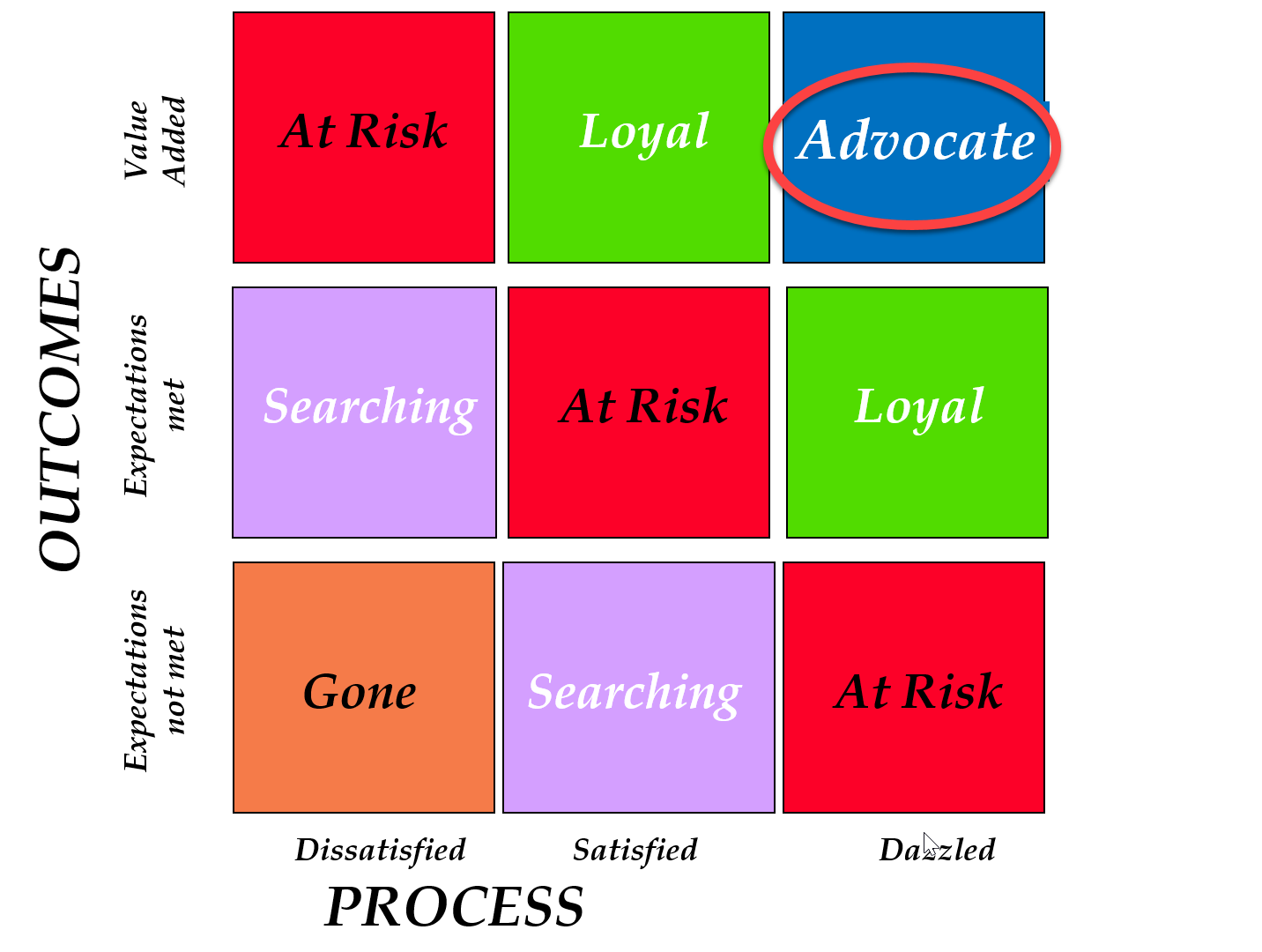
The best way to show you is with a Chart, a grid.
It looks like this:

The vertical axis is what you do – your outcomes. A law firm provides legal services. A restaurant? Meals. Clothing store? Clothes. You get the idea.
The question going up the chart is – did I ‘not meet’, ‘meet’, or exceed my customers’ expectations?
You go to a restaurant. Your meal was either crappy (not met), good (met), or just like mom’s cooking (exceeded).
Now look at the horizontal axis. It is called “Process”.
It is not how you do what you do (that is operations). It is how you deliver what you do.
Everyone knows you can get a great meal, and lousy service. It can be lousy in any number of ways.
A grumpy, rude, indifferent, or distracted server for example.
The “process” part is the people part. Did the business show they cared for you?
The Colors Are the Clue
Look carefully at the Chart above. The colors are a clue. There are 3 red boxes, 2 green, 2 purple, 1 brownish, and 1 blue.
Let me unpack it for you.
The Color Brown
The bottom corner – in our restaurant example – means the food is bad, AND the service was horrible. You are gone. And, likely you will tell a lot of people. Way more than when it is great.

The Color Purple
Look at the 2 purple boxes next. In the bottom, middle box the food is bad, but the server was friendly. (Expectations not met, satisfied with the service). In the middle, left box the food is good, and the service is horrid. (Expectations met, dissatisfied with process).

What do you do?
You are searching. You want a better restaurant to go to. Perhaps you are not gone – just yet – but actively looking!
The Color Red
Three boxes are red. Bottom right red box – you are dazzled with service; food is really awful. In top left red box – the food was terrific (better than expected), but the server was rude.
Middle red box – everything is good. Not great. Good. Food is good. Service was good. You are satisfied. Just not running home to share with your friends and family about the place.
As the business owner of this restaurant, are you secure?
No. You are “at risk”. Those customers could leave you. They will leave you when something better comes along.

The Green Boxes
There are two possibilities here. Either the food was amazing, and the service good. Or, the service was dazzling, and the food was good, not great.
You are safer here indeed. Because you have something all businesses long for.
Check it out below.

You have loyal customers.
So, what is wrong with that? Isn’t that enough. Sure. It is good. But is that what you really want? Because there is one piece missing. One secret ingredient.
Remember what I said at the beginning? The road is narrow and the gateway is small.
This leads us to the last box….
The Blue Box
The blue box is where your advocates live.
In this lonely top corner box, you have been blown away with the meal AND the service dazzled you.
And here is the lesson. The one thing advocates do (something even loyal customers do not do) is this:
- They cannot stop talking about your business
They are a walking, talking billboard for your company. They rave about you to friends and family and on social media. Stories are shared about you – good stories. They smile telling their friends about their experience. They gush a bit.
Here is the challenge (for all of us in business). Not how we get there. We may be able to pull that off – occasionally.
It is how do we stay there. How do we embed that dazzling experience with outstanding products/services into the DNA of our systems?
Thanks for reading….
PS – the above distinction applies as much – actually more – during a pandemic
by MHolland | May 27, 2020 | Business Tips
People love to shop. Businesses love to expand. Businesses and people spend what they earn…
The one thing they do not have enough of is what?
Savings.
The pandemic created a global liquidity shock. Customer A owes your business money. They lost 95% of their sales. They cannot pay you.
You, then, cannot pay your suppliers. And so on, and so on, and so on…
It is global. It is a shock. And, it means you have no cash coming in.
What to do?
Downsize, for one. Scale back. Get lean.
The pandemic has showed a lot of people what they did not do. Save money.
Most people and businesses spend what they earn. They feel this pressure to “look the part”.
When you make more, you want to drive a better car. Live in a bigger house. Wear fancier clothes.
The same is true for businesses.
And, here is the raw truth faced by everyone:
Did you save enough money to last 6 months?
I mean, enough to pay all your expenses with not a shilling coming in.
Spending Can Be an Addiction
We buy stuff for many reasons. It can be because we need something.
It may be because there is a hole inside that you are trying to fill up. And, as in all addictions, spending will not, cannot, fill that hole.
Consider it may be a desire to “look good”. You look around, your neighbours, friends, and family drive better cars. You feel “less than”. So, you spend to “keep up with the Joneses”.
Here is a rule of thumb:
Save first
Put money into a vault. Spend what is remaining. I am not suggesting becoming a miser. I am saying – save first, not last.
When you save last, there is usually nothing left. It is all spent.
Here are some focus points to think about before you spend*:
Do not shop.
Live within your means.
Take care of what you have.
Wear it out.
Do it yourself.
Anticipate your needs.
Research value, quality, durability, and multiple use.
Get it for less.
Buy used (especially cars).
*Courtesy of Joe Dominguez, Your Money or Your Life
The Most Impactful Graph, Ever
The following “fulfillment chart” is the most impactful graph, ever. I saw it years ago and it changed me.
What it shows is that fulfillment does indeed go up with each dollar spent.
In the beginning! When you have NO food, clothes, or shelter.
Money spent creates great fulfillment when buying these basics. Remember that first old beater you had when 16 or 17? I do. Loved it. How about your first little studio apartment. The one that was all yours. Fulfilling just to remember, isn’t it?
As you move up the left side of the graph (fulfillment) you reach a crossover point. That point is called “enough”. That is the point where each dollar you spend brings less and less fulfillment.
In fact, it starts going down! Yup. #truth. It goes down…
How does that work?
The effort required to “get more stuff” means more work, less savings, and higher stress.
Let me illustrate with an exaggerated example. Someone you know has a nice house, good job, wife, and 3 kids.
They want more. They buy a bigger house. House comes with fatter mortgage. But that is ok, because the husband just got promoted and has more income to cover it.
But the promotion comes with higher expectations. This means longer hours at the office. Less time with the family.
The husband – to relieve stress – has a brilliant idea! Buy a motorhome so the family can spend more time together on holidays!
The wife takes a part-time job to pay for the motorhome payments.
The family is spending less time together now. The stress has the husband drinking more and eating poorly. And then a pandemic hits. Unexpectedly.
What to Do Now (If You Did Not save)?
Cut back every discretionary expense you can. Grow your own food in a backyard garden. Start saving now. It is not too late. Get creative. A crisis forces creativity!
Remember principal number one – save first.
And, as we start to come out of this pandemic, please, do not go back to old spending habits. I repeat do not.
Thanks for reading…
